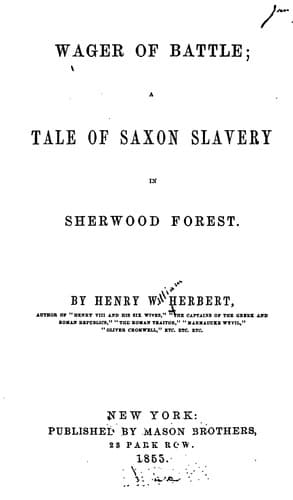
Wager of Battle: A Tale of Saxon Slavery in Sherwood ForestHerbert, Henry William
History
Wager of Battle: A Tale of Saxon Slavery in Sherwood Forest
Herbert, Henry William
Anglo-Saxons -- Fiction; Great Britain -- History -- Norman period, 1066-1154 -- Fiction; Sherwood Forest (England) -- Fiction
It was no hardness of nature or cruelty of disposition, therefore,
which led either of these noble men--for they were noble, not in birth
only, but in sentiment and soul, according to the notions of their
age, which were necessarily _their_ notions, and to the lights
vouchsafed to them--to speak concerning the Saxon serfs, and act
toward them, ever as if they were beasts of burden, worthy of care,
kindness, and some degree of physical consideration, rather than like
men, as themselves, endowed with hearts to feel and souls to
comprehend. Had they been other than they were, they had been
monsters; as it was, they were excellent men, as men went then, and go
now, fully up to the spirit of their own times, and to the strain of
morality and justice understood thereby, but not one whit above it.
Therefore, Sir Yvo de Taillebois, finding himself indebted for his
daughter's life to the hardihood and courage of the Saxon serf, whom
he regarded much as he would have done his charger or his hound,
desired, as a point of honor, rather than of gratitude, to secure to
the serf an indemnity from toil, punishment, or want, during the rest
of his life, just as he would have assigned a stall, with free rack
and manger, to the superannuated charger which had saved his own life
in battle; or given the run of kitchen, buttery, and hall, to the
hound which had run the foremost of his pack. The sensibilities of the
Saxon were as incomprehensible to him as those of the charger or the
staghound, and he thought no more of considering him in his social or
family relations, than the animals to which, in some sort, he likened
him.
He would not, it is true, if asked as a philosophical truth, whether
the life of a Saxon serf and of an Andalusian charger were equivalent,
have replied in the affirmative; for he was, according to his lights,
a Christian, and knew that a Saxon had a soul to be saved; nor would
he have answered, that the colt of the high-bred mare, or the whelp of
the generous brach, stood exactly in the same relation as the child of
the serf to its human parent; but use had much deadened his
perceptions to the distinction; and the impassive and stolid
insensibility of the Saxon race, imbruted and degraded by ages of
serfdom, caused him to overlook the faint and rarely seen displays of
human sensibilities, which would have led him less to undervalue the
sense and sentiment of his helpless fellow-countrymen. As it was, he
would as soon have expected his favorite charger or best brood mare to
pine hopelessly, and grieve as one who could not be consoled, at being
liberated from spur and saddle, and turned out to graze at liberty
forever in a free and fertile pasture, while its colts should remain
in life-long bondage, as he would have supposed it possible for the
Saxon serf to be affected beyond consolation by the death, the
deportation, or the disasters of his family.
Public-domain text, read in full here on John Shaqi.
Reviews
Reviews
No reviews yet
Be the first to share your thoughts on this work.
Join the Discussion
Join the discussion
Sign in to leave a comment or review.
Sign InorCreate an account