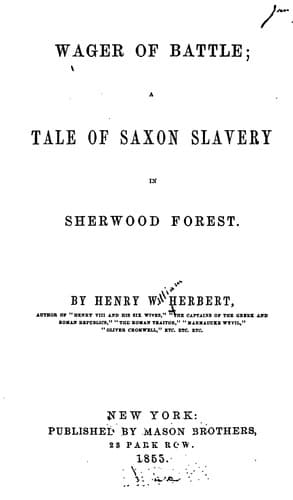
Wager of Battle: A Tale of Saxon Slavery in Sherwood Forest — John Shaqi
Wager of Battle: A Tale of Saxon Slavery in Sherwood ForestHerbert, Henry William
History
Wager of Battle: A Tale of Saxon Slavery in Sherwood Forest
Herbert, Henry William
Anglo-Saxons -- Fiction; Great Britain -- History -- Norman period, 1066-1154 -- Fiction; Sherwood Forest (England) -- Fiction
Nor, again, did he regard liberty or servitude in an abstract sense,
apart from ideas of incarceration, torture, or extreme privation, as
great and inherent right or wrong.
The serf owed him absolute service; the free laborer, or villeyn,
service, in some sort, less absolute; his vassals, man-service,
according to their degree, either in the field of daily labor, the
hunting-field, or the battle-field; he himself owed service to his
suzerain; his suzerain to the King. It was all service, and the
difference was but in the degree; and if the service of the serf was
degraded, it was a usual, a habitual degradation, to which, it might
be presumed, he was so well accustomed, that he felt it not more than
the charger his demipique, or the hawk his bells and jesses; and, for
the most part, he did not feel it more, nor regret it, nor know the
lack of liberty, save as connected with the absence of the fetters or
the lash.
And this, indeed, is the great real evil of slavery, wheresoever and
under whatsoever form it exists, that it is not more, but less,
hurtful to the slave than to the master, and that its ill effects are
in a much higher and more painful degree intellectual than physical;
that, while it degrades and lowers the inferiors almost to the level
of mere brutes, through the consciousness of degradation, the absence
of all hope to rise in the scale of manhood, and the lack of every
stimulus to ambition or exertion, it hardens the heart, and deadens
the sensibilities of the master, and renders him, through the strange
power of circumstance and custom, blind to the existence of wrongs,
sufferings, and sorrows, at the mere narration of which, under a
different phase of things, his blood would boil with indignation.
Such, then, was in some considerable degree, the state of mind,
arising from habit and acquaintance with the constitution of freedom
and slavery, intermingled every where in the then world, any thing to
the contrary of which they had never seen nor even heard of, in which
the two Norman lords took their way down the village street, if it
could be so called, being a mere sandy tract, passable only to
horsemen, or carts and vehicles of the very rudest construction,
unarmed, except with their heavy swords, and wholly unattended, on an
errand, as they intended, of liberality and mercy.
The quarter of the serfs of Sir Philip de Morville was, for the most
part, very superior to the miserable collection of huts, liker to
dog-houses than to any human habitation, which generally constituted
the dwellings of this forlorn and miserable race; for the knight was,
as it has been stated, an even-tempered and good-natured, though
common-place man; and being endowed with rather an uncommon regard for
order and taste for the picturesque, he consequently looked more than
usual to the comfort of his serfs, both in allotting them small plots
of garden-ground and orchards, and in bestowing on them building
materials of superior quality and appearance.
Public-domain text, read in full here on John Shaqi.
Reviews
Reviews
No reviews yet
Be the first to share your thoughts on this work.
Join the Discussion
Join the discussion
Sign in to leave a comment or review.
Sign InorCreate an account