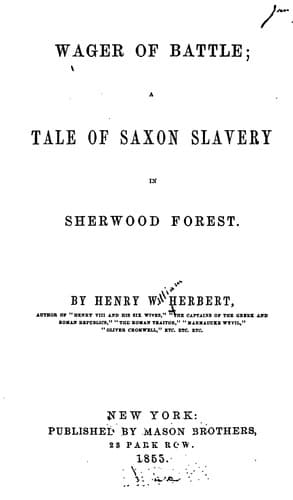
Wager of Battle: A Tale of Saxon Slavery in Sherwood Forest — John Shaqi
Wager of Battle: A Tale of Saxon Slavery in Sherwood ForestHerbert, Henry William
History
Wager of Battle: A Tale of Saxon Slavery in Sherwood Forest
Herbert, Henry William
Anglo-Saxons -- Fiction; Great Britain -- History -- Norman period, 1066-1154 -- Fiction; Sherwood Forest (England) -- Fiction
When, in a subsequent insurrection, the Norman king again marched
northward, in full resolve to carry his conquering arms to the
frontiers of Scotland, and, sustained by his ferocious energy, did
actually force his way through the misty moorlands and mountainous
mid-regions of Durham, Northumberland, and Westmoreland, he had to
traverse about sixty miles of country, once not the least fertile of
his newly-conquered realm, in which his mail-clad men-at-arms saw
neither green leaves on the trees, nor green crops in the field; for
the ax and the torch had done their work, not negligently; passed
neither standing roof nor burning hearth; encountered neither human
being nor cattle of the field; only the wolves, which had become so
numerous from desuetude to the sight of man, that they scarce cared to
fly before the clash and clang of the marching squadrons.
To the northward and north-westward, yet, of Yorkshire, including what
are now Lancashire, Westmoreland, Northumberland, and Cumberland,
though the Conqueror, in his first irresistible prosecution of
red-handed victory, had marched and countermarched across them, there
was, even at the time of my narrative, when nearly a century had fled,
little if any thing of permanent progress or civilization, beyond the
establishment of a few feudal holds and border fortresses, each with
its petty hamlet clustered beneath its shelter. The marches, indeed,
of Lancashire, toward its southern extremity, were in some degree
permanently settled by military colonists, in not a few instances
composed of Flemings, as were the Welch frontiers of the neighboring
province of Cheshire, planted there to check the inroads of the still
unconquered Cymri, to the protection of whose mountains, and
late-preserved independence, their whilom enemies, the now persecuted
Saxons, had fled in their extremity.
It is from these industrious artisans, then the scorn of the high-born
men-at-arms, that the trade had its origin, which has filled the bleak
moors, and every torrent gorge of Lancaster and Western York, with a
teeming population and a manufacturing opulence, such as, elsewhere,
the wide earth has not witnessed. Even at the time of which I write,
the clack of their fulling-mills, the click of their looms, and the
din of their trip-hammers, resounded by the side of many a lonely
Cheshire stream; but all to the north and westward, where the wildest
hillsides and most forbidding glens are now more populous and richer
than the greatest cities of those days, all was desolate as the aspect
of the scenery, and inhospitable as the climate that lowers over it in
constant mist and darkness.
Public-domain text, read in full here on John Shaqi.
Reviews
Reviews
No reviews yet
Be the first to share your thoughts on this work.
Join the Discussion
Join the discussion
Sign in to leave a comment or review.
Sign InorCreate an account