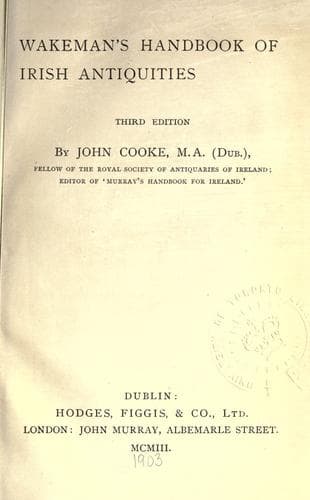
Wakeman's handbook of Irish antiquitiesWakeman, W. F. (William Frederick)
History
Wakeman's handbook of Irish antiquities
Wakeman, W. F. (William Frederick)
Ireland -- Antiquities
Many theories have been advanced with respect to their origin. They are
variously supposed to have been idol-stones, to have been erected as
landmarks, and as monumental stones recording the scene of a battle,
or the spot upon which a warrior had fallen. The name ‘cat-stone,’ by
which some examples are known in Scotland, would well warrant such an
idea, the word ‘cath’ in the Gaelic language signifying a battle. At
either end of the historic ford over the river Erne, at Ballyshannon,
may be seen two remarkable examples--to that on the northern side other
stones would seem to lead. This is a significant fact in favour of the
landmark theory. At the same time, we learn from the later writers
of the life and labours of St. Patrick in Ireland, that he found the
people worshipping certain idols in the form of stone pillars, some
of which he caused to be overthrown, while upon one purposely left
standing he inscribed the name of Jesus. There can be little doubt that
the saint and his immediate followers, in their horror of all that was
idolatrous, destroyed a large number of the pillar-stones which had
been venerated and worshipped in pagan Ireland; but, nevertheless,
a considerable number still remain. These, in some instances, would
seem to have been consecrated to the Faith, and from having been idols
were transformed into memorials of the triumph of Christianity. We
are not without satisfactory evidence of such adaptation having been
effected. Several, and apparently the oldest, lithic monuments may be
observed rudely punched, not carved, with the figure of a primitive
cross, accompanied by one or other of the inscriptions DNI, DNO, or
DOM. Todd, in his _Life of St. Patrick_, has, we believe, conclusively
shown the generally received idea of the sudden, and, it may be said,
miraculous conversion of Ireland in the days of the saint, and in
those of his immediate successors, to be wholly erroneous. Pagan
practices and beliefs long remained, and to-day many myths, legends,
and superstitions attest, as dying remnants, how deeply rooted were the
‘elder faiths.’
The Pillar-stone is the simplest form of all memorials; it is found in
other countries in connection with ancient burial mounds or barrows.
Such memorials to a departed hero, chief, or monarch were not confined
to savage peoples, for the custom has descended through all stages of
civilization, and the commemorative use of the pillar-stone is frequent
in biblical history. Ancient Egypt furnishes notable examples of
monoliths such as Cleopatra’s Needle; while the metropolis of Ireland,
not to mention other cities, exhibits stupendous pillar monuments
showing the ‘hero-worship’ of our forefathers, to the dead leaders
Wellington and Nelson.
Public-domain text, read in full here on John Shaqi.
Reviews
Reviews
No reviews yet
Be the first to share your thoughts on this work.
Join the Discussion
Join the discussion
Sign in to leave a comment or review.
Sign InorCreate an account