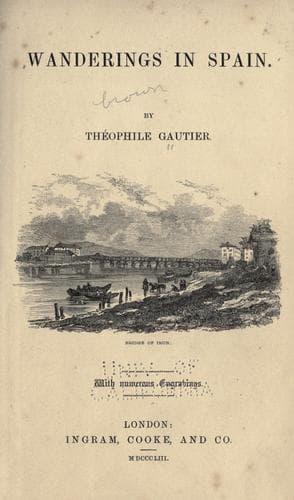
Gautier, Théophile, 1811-1872 -- Travel -- Spain; Spain -- Description and travel; Spain -- Social life and customs -- 19th century
It is about this spot that the long orgy of stone commences,
which ends only at Bordeaux. The smallest hut, without doors or
windows, is of stone; the walls of the gardens are formed of large
blocks placed one above the other without mortar; along the road,
by the side of the doors, you perceive enormous heaps of superb
stone, with which it would be easy, at a trifling expense, to build
new _Chenonceaux_ and Alhambras. The inhabitants, however, are
contented with piling them in squares, and surmounting the whole
with a cover of red or yellow tiles, the different forms of which
compose a festoon of a tolerably graceful effect.
The town of Angoulême, queerly perched on an extremely steep hill,
at the foot of which the Charente turns two or three babbling
mills, is built in the same manner. It has a kind of second-hand
Italian look, which is increased still more by the thick masses of
trees which crown its rugged eminences, and a tall parasol-shaped
pine, like those of the Roman villas. An old tower, which, if my
memory does not deceive me, is surmounted by a telegraph (many
old towers have been saved by a telegraph), imparts a tone of
severity to the general aspect of the town, and renders it a
tolerably imposing object on the edge of the horizon. While toiling
up the ascent, I remarked a house daubed externally with rude
frescoes representing something like Bacchus, Neptune, or perhaps
Napoleon. As the artist forgot to paint the name underneath, every
supposition is admissible and capable of being defended.
As yet, I confess that an excursion to Romainville or Pantin would
have been quite as picturesque. Nothing can be more flat, more
inane, more insipid, than these interminable strips of ground,
similar to the little bands with which lithographers enclose all
the Boulevards of Paris in one sheet of paper. Hedges of hawthorn
and consumptive-looking elms, consumptive-looking elms and
hedges of hawthorn, with, a little further on, a row of poplars,
resembling a number of green feathers stuck in a flat soil, or
perhaps a solitary willow, with its deformed trunk and powdered
wig, compose the landscape; while, for figures, you have that of
some _pionnier_, or _cantonnier_, as sunburnt as a Moor, leaning
upon the handle of his long hammer as he looks at you pass by,
or else some poor soldier rejoining his regiment, and sweating
and staggering under his harness. Beyond Angoulême, however, the
physiognomy of the soil changes, and you begin to feel that you are
at a certain distance from the suburbs of the Capital.
Public-domain text, read in full here on John Shaqi.
Reviews
Reviews
No reviews yet
Be the first to share your thoughts on this work.
Join the Discussion
Join the discussion
Sign in to leave a comment or review.
Sign InorCreate an account