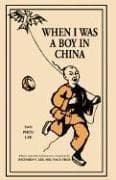
China -- Social life and customs -- 1644-1912; Lee, Yan Phou, 1861-1938?
There are hardly any sports, so-called, that develop the muscles and
render a lad graceful and agile. The Chinese boy at sixteen is as grave
and staid as an American grandfather; and if he happens to be married
soon after, he throws aside most games as being childish. At the
best, he has nothing corresponding to base-ball, foot-ball, cricket,
bicycle-riding, skating, sliding, or tennis. Nor is he fond of exerting
himself. He would rather sit for hours talking and joking than waste
time in running or jumping. He thinks it work if his play entails
much perspiration. His elders, too, frown upon boisterous games. They
approve quiet, meditative lads who are given to study.
But you must not suppose that the Chinese boy never plays at all. In
spite of many obstacles, he proves that he is a boy still, and I will
describe the outdoor amusements in which he does indulge.
Kite-flying is a national recreation. Young and old take part in it
and it is not unusual to see a gray-haired man enjoying it in company
with a ten-year-old youngster. Kites are of all sizes. I have seen
kites that were six or seven feet from wing to wing. The frame is made
of bamboo slips which can be easily bent. Over this is pasted very
stout rice-paper, upon which strong figures are painted—sometimes the
face of a man, sometimes a bird. On the larger kites a bow is fastened
at the top, with a reed instead of a string, and when the wind blows
upon this reed, a melodious sound will be heard through the air, that
greatly delights everybody; it seems to the spectators a mysterious
voice from a different sphere.
Kite-flying in America can be much improved. Kites should be
constructed of the Chinese shape.
The rib that runs through both wings should bulge out so that the paper
on both sides may cave in. This is for the purpose of catching and
retaining the wind as well as of steadying the kite. To a kite of this
shape a tail is needless.
[Illustration: FRAME OF A CHINESE KITE.]
To fly such a kite, the cord must be very strong, and often it requires
two or three men to hold it. When it gets among the clouds, and
the flyer’s enthusiasm is at its boiling-point, a paper butterfly,
beautifully colored, is fastened on the cord and the wind sends it up
with a whizzing sound to the kite itself. But when it touches the kite,
the butterfly’s wings come together, and down it returns, by its own
weight, bringing a message from the skies, and its graceful approach is
watched breathlessly.
The ninth day of the ninth month, which comes in October, is “Kites’
Day.” On that day it is the fashion to go up high hills and hold
communion with heavenly zephyrs. Such a scene is inspiring. Men and
boys, of all ranks, sizes and ages, are seen with cords in their hands,
pulling, yanking and jerking, or letting loose, all sorts of agile
rice-paper monsters in the azure sky. The fun consists in making the
kites fight—in entangling them and cutting one another’s strings by
sudden jerks.
Public-domain text, read in full here on John Shaqi.
Reviews
Reviews
No reviews yet
Be the first to share your thoughts on this work.
Join the Discussion
Join the discussion
Sign in to leave a comment or review.
Sign InorCreate an account