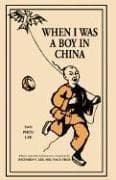
China -- Social life and customs -- 1644-1912; Lee, Yan Phou, 1861-1938?
Dominoes is a game played by men and women as well as children. It is
different from the American game, being more like the card game of
whist.
Guessing Pennies always furnishes much amusement to little boys and
girls. Chinese coins are made of brass and copper, with a square hole
in the middle for convenience in carrying. On one side is a legend
in Chinese giving the name of the emperor’s reign and the words
“_Tung-pao_,” i. e., _currency_. The game is to guess the
name of the reign, when the coin is turned upside down. Another game
is played around fruit-stand; it is to guess the number of seeds in an
orange. The loser pays for the orange while the winner eats it.
There are not many games in which boys and girls play together. If
they do play together it is only while they are children, under ten or
twelve. Growing-up girls will have nothing whatever to do with boys,
though Chinese boys and girls are very sociable, each with friends of
their own sex.
CHAPTER V.
GIRLS OF MY ACQUAINTANCE.
I still continually find false ideas in America concerning Chinese
customs, manners, and institutions. Small blame to the people at large,
who have no means of learning the truth except through newspapers or
accounts of travellers who do not understand what they see in passing
through our country. From the time of Sir John Mandeville, travellers
(with a few noble exceptions) have vied with each other in relating
the most wonderful stories about our ancient empire. Accordingly, what
I tell in this series of articles about Chinese customs, manners and
institutions may often contradict general belief.
There is far less of truth told about the “fair section” of the Chinese
people than of the sterner sex, because far less is known. What I
myself propose to tell is chiefly derived from daily observation of
the female members of my family and those of my kindred. Very distant
relatives are recognized in China; a man prides himself upon the large
number of his connections as well as upon the influence his family
exert in the community on account of wealth or position. A “poor
relation” there is treated with much more consideration and affection
than in this country. Generosity towards that class of unfortunates is
so common, and its practice is so strenuously insisted upon, in the
moral code of the Chinese, that it almost ceases to be an individual
virtue—it is a national virtue.
Public-domain text, read in full here on John Shaqi.
Reviews
Reviews
No reviews yet
Be the first to share your thoughts on this work.
Join the Discussion
Join the discussion
Sign in to leave a comment or review.
Sign InorCreate an account