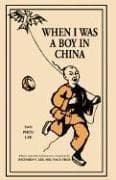
China -- Social life and customs -- 1644-1912; Lee, Yan Phou, 1861-1938?
Speaking of the winter season: The climate in the city of my nativity
is like that of Canton which lies seventy-five miles to the north.
Although no snow falls, and although ice is an unknown quality there,
yet the weather is sufficiently chilly to make a fire desirable. But
Chinese houses, strangely enough I now think, are built for summer, and
to counteract heat rather than to keep off cold; and no such furniture
as a heating stove is known, neither furnaces, nor steam-heaters. So
for warmth we resort to thick clothing, and all sleeves are cut long
with that end in view. A funny consequence is that old and young look
twice as big in winter as in summer.
As a baby I had my playthings—bells, rattles and other knick-knacks.
But there is no such blessed thing as a cradle among the Chinese in
which baby may be soothed and rocked to sleep, neither the healthful,
separate “crib.” I had to sleep with my mother; and I have not a
doubt that I used to cry a deal because I felt too warm, for the
bedclothes—which were plentiful and heavily padded—would sometimes
cover me all up and make it difficult for me to breathe. I would be
suffocated, smothered, and of course I would cry; and my mother would
do everything except give me air and liberty; numberless were the
medicines administered, for Chinese doctors pretend they can cure
the crying of children at night. American mothers have no idea what
impositions Chinese mothers suffer from physicians and sellers of
charms, on account of their superstitious fears concerning the health
and welfare of their children.
In the daytime I used to sit in a bamboo chair which had a board in
front that slid back and forth and served both as a table to hold my
playthings and a lock to keep me in my seat, for it came up to my
waist, so it was not possible for me to leap out. In this stiff fixture
I used to sit hours at a time and watch my mother spin flax.
Our Oriental tastes are too simple to contrive such luxuries as
baby-carriages. We have instead our “carrying tie.” This consists
of a piece of thick cloth, about two feet square, lined inside, and
embroidered outside with beautiful figures, and having four bands sewed
on, one at each corner. To put me into this cloth carriage, the one who
was to carry me, my mother or a servant, would lean over; I was then
laid on her back, the “carriage” thrown over me, and the upper bands
tied around the bosom of the carrier, the lower ones around her waist.
My legs, of course, dangled outside; but it was nevertheless a very
comfortable seat for me, though I doubt if it were so pleasant for the
one who lugged me about. The primary object of this contrivance was to
get me to sleep, and many a fine nap I must have had in my “carriage.”
If I persisted in keeping awake, my carrier would sing to me a lullaby
which, being ordinary conversation put to music more or less tuneful,
is hardly worth a translation.
Public-domain text, read in full here on John Shaqi.
Reviews
Reviews
No reviews yet
Be the first to share your thoughts on this work.
Join the Discussion
Join the discussion
Sign in to leave a comment or review.
Sign InorCreate an account