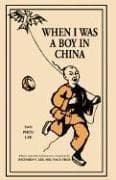
China -- Social life and customs -- 1644-1912; Lee, Yan Phou, 1861-1938?
My earliest recollections are of a sitting-room on the ground floor of
my grandsire’s house, the right wing of which was assigned to my father
at the time of his marriage. It was very long and narrow, with bare
brick walls in which no windows opened upon the street; all the light
and ventilation came through a long narrow opening in the roof. Rain
came through too, as well as light and air, and had to be drained off.
The furniture of this room was simple; a bamboo sofa, a square table,
a few stiff-backed chairs, three long and narrow benches and a couple
of stools. This ascetic simplicity in furnishings may be noticed
everywhere in China; nowhere are even the rich inclined to indulge in
luxury to any extent.
I remember very well the comfortless Chinese bed. Boards took the place
of springs, and benches supported these boards. In ours, surmounting
all was a heavy canopy frame, which, when new, was evidently gilded and
carved. By this frame was suspended mosquito nettings, an absolutely
necessary arrangement. The ground was our floor, overlaid with bricks a
foot square as carpet. No chimney was to be seen anywhere, no heating
apparatus, hardly any ornaments. In summer these rooms were cool and
comfortable; but the winter’s wind and cold rendered them cheerless.
There is only one event of my infant life worthy of record, the death
of my adopted father. He was my father’s brother and had accompanied
my grandfather to the city of his literary administration. He was
but a youth of twenty-one, unmarried and studying for the public
examinations. On his deathbed, he designated me as his adopted son and
heir. My grandfather ratified the choice, so that without my consent I
was transferred from my father’s hands into my uncle’s.
This mode of adoption is common. Usually the adopted son belongs to the
same family or clan, but not always; in any case he has the rights,
privileges and duties of a born son. Among the rights may be mentioned
the inheriting of property, and among the duties the annual offerings
at the family altar and the grave, and the daily burning of remembrance
incense.
CHAPTER II.
THE HOUSE AND HOUSEHOLD.
Babyhood is the most enjoyable stage in the life of an Oriental. It is
the only period when his wishes are regarded and when demonstrations of
affection are shown him. The family regulations in China are such that
so soon as a child begins to understand, he is not only taught to obey,
but also loses his freedom of action; nor does he fully recover it till
he is old and past the brief season of youthful enjoyment.
Public-domain text, read in full here on John Shaqi.
Reviews
Reviews
No reviews yet
Be the first to share your thoughts on this work.
Join the Discussion
Join the discussion
Sign in to leave a comment or review.
Sign InorCreate an account