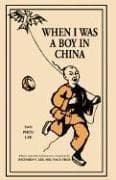
China -- Social life and customs -- 1644-1912; Lee, Yan Phou, 1861-1938?
Indeed, among the lower and less educated classes, we find family
discipline less strict than among the higher orders of our people. I
happened to be born into the higher middle condition of life. There
is no such thing as caste in China, in the sense that caste exists in
India. In China, wealth, and literary and official honors ennoble a
family and can lift it from a lower to a higher plane. The regulations
and government of my family were as rigorous as possible. I lived
the years of my childhood in a shrinking condition of mind. Like all
youngsters, I wanted to shout, jump, run about, show my resentments,
and my affections, give my animal spirits and affectionate impulses
full play. But like a colt in training for the harness I was checked
and curbed, my tongue was bridled, and my feet clogged, by fear of my
elders. My father was a stern man as was his father before him. I
remember him vividly by the beatings I got from him.
Yet he was truly good and kind.
Though the times when I required punishment were comparatively rare, I
remember a constant sense of dread lest I should do something out of
the way of a well-bred Chinese lad. The bamboo rod hung over my head
like the sword of Damocles. My mother (who is still living) saved me
from its blows many a time by giving me timely warning or by keeping my
misdemeanors from my father’s knowledge. But she was not so foolishly
indulgent as to spare me when I truly deserved punishment.
Our immediate family consisted of my parents, a brother four years
older than I, one two years younger, and myself. I had two sisters who
had died before my birth; by the course of nature, let me add, for the
horrible practice of female infanticide was in our part of the empire
only heard of in stories, and not without a shudder.
I have previously said we occupied a part of my grandfather’s house.
The building had only one floor. The accompanying plan describes it:
[Illustration: PLAN OF A CHINESE HOUSE.]
“A” stands for those spaces over which the roof was open to the sky,
and which corresponded to the _compluvium_ in the dwellings of the
Romans. There were five of them in our house. Through them came air,
wind and rain. You may easily conjecture that such openings in Chinese
houses must be favorite entrances and exits for burglars and thieves.
At night there seems to be no protection against such gentry except the
wakefulness and bravery of watchmen, who, by striking the hour of night
on a piece of bamboo in going the rounds, only warn the burglars to
keep out of sight while they are near. The Chinese watchman serves the
double purpose of a patrolman and a perambulating clock; and although
clocks are in common use, my countrymen have not yet employed bells to
toll the hour for the whole city.
Public-domain text, read in full here on John Shaqi.
Reviews
Reviews
No reviews yet
Be the first to share your thoughts on this work.
Join the Discussion
Join the discussion
Sign in to leave a comment or review.
Sign InorCreate an account