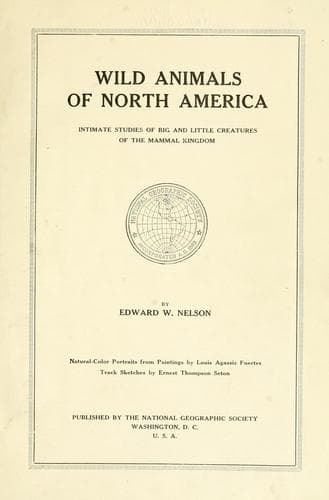
Wild Animals of North America: Intimate Studies of Big and Little Creatures of the Mammal KingdomNelson, Edward William
Science
Wild Animals of North America: Intimate Studies of Big and Little Creatures of the Mammal Kingdom
Nelson, Edward William
Mammals -- North America
Raccoons occupy most of the wooded parts of North America from the
southern border of Canada to Panama, with the exception of the higher
mountain ranges. In the United States they are most plentiful in the
Southeastern and Gulf States and on the Pacific coast. Under the
varying climatic conditions of their great range a number of geographic
races have developed, all of which have a close general resemblance in
habits and appearance.
They everywhere seek the wooded shores of streams and lakes and the
bordering lowland forests and are expert tree-climbers, commonly having
their dens in hollow trees, often in cavities high above the ground.
In such retreats they have annually from four to six young, which
continue to frequent this retreat until well grown, thus accounting for
the numbers often found in the same cavity. Although tree-frequenting
animals, the greater part of their activities is confined to the
ground, especially along the margins of water-courses. While almost
wholly nocturnal in habits, they are occasionally encountered abroad
during the day.
Their diet is extraordinarily varied, and includes fresh-water clams,
crawfish, frogs, turtles, birds and their eggs, poultry, nuts, fruits,
and green corn. When near water they have a curious and unique habit
of washing their food before eating it. Their fondness for green corn
leads them into frequent danger, for when bottom-land cornfields tempt
them away from their usual haunts raccoon hunting with dogs at night
becomes an especially favored sport.
Raccoons are extraordinarily intelligent animals and make interesting
and amusing pets. During captivity their restless intelligence is
shown by the curiosity with which they carefully examine every strange
object. They are particularly attracted by anything bright or shining,
and a piece of tin fastened to the pan of a trap serves as a successful
lure in trapping them.
They patrol the border of streams and lakes so persistently that where
they are common they sometimes make well-trodden little trails, and
many opened mussel shells or other signs of their feasts may be found
on the tops of fallen logs or about stones projecting above the water.
In the northern part of their range they hibernate during the coldest
parts of the winter, but in the South are active throughout the year.
Raccoons began to figure in our frontier literature at an early date.
“Coon-skin” caps, with the ringed tails hanging like plumes, made the
favorite headgear of many pioneer hunters, and “coon skins” were a
recognized article of barter at country stores. Now that the increasing
occupation of the country is crowding out more and more of our wild
life, it is a pleasure to note the persistence with which these
characteristic and interesting animals continue to hold their own in so
much of their original range.
CANADA LYNX (Lynx canadensis)
Public-domain text, read in full here on John Shaqi.
Reviews
Reviews
No reviews yet
Be the first to share your thoughts on this work.
Join the Discussion
Join the discussion
Sign in to leave a comment or review.
Sign InorCreate an account