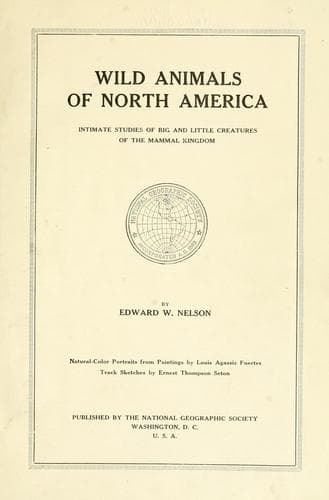
Wild Animals of North America: Intimate Studies of Big and Little Creatures of the Mammal KingdomNelson, Edward William
Science
Wild Animals of North America: Intimate Studies of Big and Little Creatures of the Mammal Kingdom
Nelson, Edward William
Mammals -- North America
The lynxes are long-legged, short-bodied cats, with tufted ears and a
short “bobbed” tail. They are distributed from the northern limit of
trees south into the Temperate Zone throughout most of the northern
part of both Old and New Worlds. In North America there are two
types--the smaller animal, southern in distribution, and the larger,
or Canada lynx, limited to the north, where its range extends from the
northern limit of trees south to the northern border of the United
States. It once occupied all the mountains of New England and south in
the Alleghenies to Pennsylvania. In the West it is still a habitant of
the Rocky Mountains as far south as Colorado, and of the Sierra Nevada
nearly to Mount Whitney.
The Canada lynx is notable for the beauty of its head, one of the most
striking among all our carnivores. This species is not only much larger
than its southern neighbor, the bay lynx, but may also be distinguished
from it by its long ear tips, thick legs, broad spreading feet, and the
complete jet-black end of the tail. It is about 3 feet long and weighs
from 15 to over 30 pounds. As befits an animal of the great northern
forests, it has a long thick coat of fur, which gives it a remarkably
fluffy appearance. Its feet in winter are heavily furred above and
below and are so broad that they serve admirably for support in deep
snow, through which it would otherwise have to wade laboriously.
This animal does not attack people, though popular belief often credits
it with such action. It feeds mainly on such small prey as varying
hares, mice, squirrels, foxes, and the grouse and other birds living
in its domain; but on occasion it even kills animals as large as
mountain sheep. One such feat was actually witnessed above timberline
in winter on a spur of Mount McKinley. The lynx sprang from a ledge as
the sheep passed below, and, holding on the sheep’s neck and shoulders,
it reached forward and by repeatedly biting put out its victim’s eyes,
thus reducing it to helplessness.
The chief food of the Canada lynx is the varying hare, which throughout
the North periodically increases to the greatest abundance and holds
its numbers for several years. During these periods the fur sales in
the London market show that the number of lynx skins received increases
proportionately with those of the hare. When an epizoötic disease
appears, as it does regularly, and almost exterminates the hares, there
is an immediate and corresponding drop in the number of lynx skins
sent to market. This evidences one of Nature’s great tragedies, not
only among the overabundant hares, but among the lynxes, for with the
failure of their food supply over a vast area tens of thousands of them
perish of starvation.
Public-domain text, read in full here on John Shaqi.
Reviews
Reviews
No reviews yet
Be the first to share your thoughts on this work.
Join the Discussion
Join the discussion
Sign in to leave a comment or review.
Sign InorCreate an account