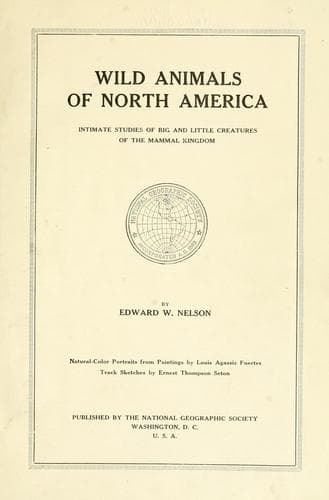
Wild Animals of North America: Intimate Studies of Big and Little Creatures of the Mammal Kingdom — John Shaqi
Wild Animals of North America: Intimate Studies of Big and Little Creatures of the Mammal KingdomNelson, Edward William
Science
Wild Animals of North America: Intimate Studies of Big and Little Creatures of the Mammal Kingdom
Nelson, Edward William
Mammals -- North America
The Canada lynx has from two to five kittens, which are marked with
dusky spots and short bands, indicating an ancestral relationship to
animals similar to the ocelot, or tiger-cat, of the American tropics.
The young usually keep with the mother for nearly a year. Such families
no doubt form the hunting parties whose rabbit drives on the Yukon
Islands were described to me by the fur traders and Indians of the
Yukon Valley.
During sledge trips along the lower Yukon I often saw the distinctive
broad, rounded tracks of lynxes, showing where they had wandered
through the forests or crossed the wide, snow-covered river channel.
Here and there, as the snow became very deep and soft, the tracks
showed where a series of leaps had been made. Lynx trails commonly led
from thicket to thicket where hares, grouse, or other game might occur.
Canada lynxes appear to be rather stupid animals, for they are readily
caught in traps, or even in snares, and, like most cats, make little
effort to escape.
=BOBCAT, OR BAY LYNX= (=Lynx ruffus= and its subspecies)
The bay lynx, bobcat, or wildcat, as _Lynx ruffus_ and its close
relatives are variously called in different parts of the country, is
one of the most widely distributed and best known of our wild animals.
It is about two-thirds the size of the Canada lynx and characterized by
much slenderer proportions, especially in its legs and feet. The ears
are less conspicuously tufted and the tip of the tail is black only on
its upper half. Bobcats range from Nova Scotia and southern British
Columbia over practically all of the wooded and brushy parts of the
United States except along the northern border, and extend south to the
southern end of the high table-land of Mexico.
[Illustration: OPOSSUM]
[Illustration: RACCOON]
From the earliest settlement of America the bobcat has figured
largely in hunting literature, and the popular estimate of its
character is well attested by the frontier idea of the superlative
physical prowess of a man who can “whip his weight in wildcats.”
Although our wildcat usually weighs less than 20 pounds, if its reputed
fierceness could be sustained it would be an awkward foe. But, so far
as man is concerned, unless it is cornered and forced to defend itself,
it is extremely timid and inoffensive.
[Illustration: CANADA LYNX]
[Illustration: BOBCAT (Bay Lynx)]
Like all cats, it is very muscular and active, and to the rabbits,
squirrels, mice, grouse, and other small game upon which it feeds is a
persistent and remorseless enemy. Although an expert tree-climber, it
spends most of its time on the ground, where it ordinarily seeks its
prey. It is most numerous in districts where birds and small mammals
abound, and parts of California seem especially favorable for it. At a
mountain ranch in the redwood forest south of San Francisco one winter
some boys with dogs killed more than eighty bobcats.
Public-domain text, read in full here on John Shaqi.
Reviews
Reviews
No reviews yet
Be the first to share your thoughts on this work.
Join the Discussion
Join the discussion
Sign in to leave a comment or review.
Sign InorCreate an account