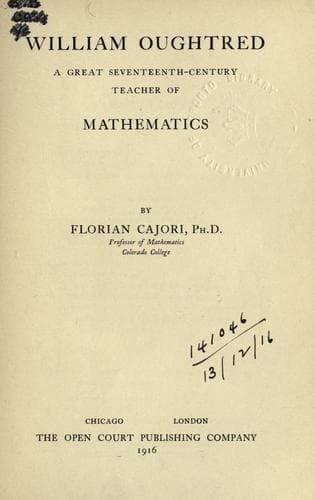
William Oughtred: A Great Seventeenth-Century Teacher of Mathematics — John Shaqi
William Oughtred: A Great Seventeenth-Century Teacher of MathematicsCajori, Florian
History
William Oughtred: A Great Seventeenth-Century Teacher of Mathematics
Cajori, Florian
Mathematicians -- Biography; Mathematics -- Study and teaching -- History -- 17th century; Oughtred, William, 1575-1660
Oughtred introduces an interesting, and at the same time new, feature of
an abbreviated multiplication and an abbreviated division of decimal
fractions. On this point he took a position far in advance of his time.
The part on abbreviated multiplication was rewritten in slightly enlarged
form and with some unimportant alterations in the later edition of the
Clavis. We give it as it occurs in the revision. Four cases are given. In
finding the product of 246|914 and 35|27, “if you would have the Product
without any Parts” (without any decimal part), “set the place of Unity of
the lesser under the place of Unity in the greater: as in the Example,”
writing the figures of the lesser number in inverse order. From the
example it will be seen that he begins by multiplying by 3, the
right-hand digit of the multiplier. In the first edition of the Clavis he
began with 7, the left digit. Observe also that he “carries” the nearest
tens in the product of each lower digit and the upper digit one place to
its right. For instance, he takes 7×4=28 and carries 3, then he finds
7×2+3=17 and writes down 17.
2 4 6|9 1 4
7 2|5 3
-------
7 4 0 7
1 2 3 5
4 9
1 7
-------
8 7 0 8
The second case supposes that “you would have the Product with some
places of parts” (decimals), say 4: “Set the place of Unity of the lesser
Number under the Fourth place of the Parts of the greater.” The
multiplication of 246|914 by 35|27 is now performed thus:
2 4 6|9 1 4
7 2|5 3
---------------
7 4 0 7 4 2 0 0
1 2 3 4 5 7 0 0
4 9 3 8 2 8
1 7 2 8 4 0
---------------
8 7 0 8|6 5 6 8
In the third and fourth cases are considered factors which appear as
integers, but are in reality decimals; for instance, the sine of 54° is
given in the tables as 80902 when in reality it is .80902.
Of interest as regards the use of the word “parabola” is the following:
“The Number found by Division is called the Quotient, or also Parabola,
because it arises out of the Application of a plain Number to a given
Longitude, that a congruous Latitude may be found.”[26] This is in
harmony with etymological dictionaries which speak of a parabola as the
application of a given area to a given straight line. The dividend or
product is the area; the divisor or factor is the line.
Public-domain text, read in full here on John Shaqi.
Reviews
Reviews
No reviews yet
Be the first to share your thoughts on this work.
Join the Discussion
Join the discussion
Sign in to leave a comment or review.
Sign InorCreate an account