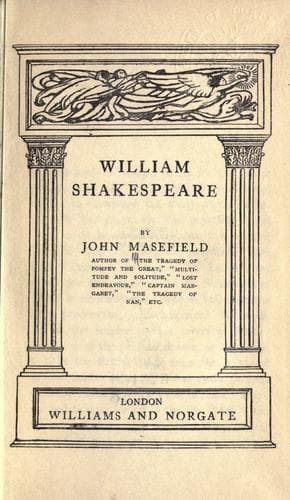
Shakespeare, William, 1564-1616 -- Criticism and interpretation
All through the play there are warnings against human certainty. Of all
the dangerous pronouncements of man that to the fountain, "Fountain, of
thy water I will never drink," is one of the most dangerous. There are
terrible examples of certainty betrayed. Richard is certain as only fine
intellect can be that he will triumph. It is a part of his tragedy that
it is not intellect that triumphs in this world, but a stupid, though a
righteous something, incapable of understanding intellect. Rivers and
Grey are certain that Richard is friendly to them. They are hurried to
Pomfret and put to death. Hastings "Knows his state secure," and "goes
triumphant." He is rushed out of life at a moment's notice, one hour a
lord, giving his opinion at a council, the next a corpse in its grave.
Buckingham thinks himself secure. A moment's nicety of conscience sends
him flying to death. The little Princes lay down to sleep--
"girdling one another
Within their innocent alabaster arms.
Their lips were four red roses on a stalk
Which in their summer beauty kissed each other"--
when their waking time came they were stamped down under the stones at
the stair foot.
The poetry of this play is that of great and high spiritual invention.
There is much that stays in the mind as exquisitely said and beautifully
felt. But the wonder of the work is in the greatness of the conception.
That is truly great, both as poetry and as drama. The big and burning
imaginings do not please, they haunt.
The dream of Clarence, the wooing of the Lady Anne, the scene in
Baynard's Castle, and the ghost scene in the tents at Bosworth, have
been praised and re-praised. They are in Shakespeare's normal mood,
neither greater nor less than twenty other scenes in the mature plays.
The really grand scene of the calling down of the curses (Act I, sc.
iii), when the man's mind, after brooding on this event for months, sees
it all, for a glowing hour, as the just God sees it, is the wonderful
achievement. Think of this scene, and think of the scenes played nightly
now in the English theatres, and ask whether all is well with the
nation's soul.
There are many superb Shakespearean openings. No poet in history opens a
play with a more magnificent certainty. The opening of this play--
"Now is the winter of our discontent
Made glorious summer by this sun of York,"
is one of the most splendid of all. There is no need to pick out
fragments from the rest of the play, but the march of the line--
"Your fire-new stamp of honour is scarce current"--
the lines--
"then came wandering by
A shadow like an angel, with bright hair
Dabbled in blood; and he squeaked out aloud,
'Clarence is come; false, fleeting, perjured Clarence,
That stabbed me in the field by Tewkesbury'"--
the exquisitely tender lines--
"And there the little souls of Edward's children
Whisper the spirits"--
Public-domain text, read in full here on John Shaqi.
Reviews
Reviews
No reviews yet
Be the first to share your thoughts on this work.
Join the Discussion
Join the discussion
Sign in to leave a comment or review.
Sign InorCreate an account