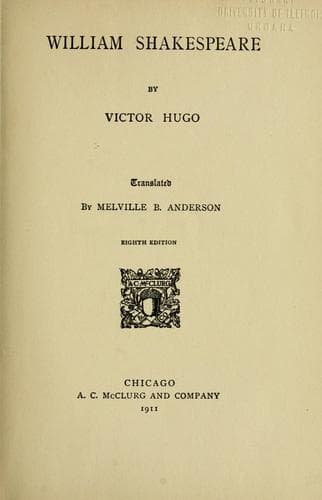
Dramatists, English -- Early modern, 1500-1700 -- Biography; Shakespeare, William, 1564-1616; Stratford-upon-Avon (England) -- Biography
his eyes, _lasciva oscula et prœnuntias flagitii blanditias_; and he
denounces to the world this effort of a monstrous and trembling mother
to make the parricide miscarry by incest. Whatever Justus Lipsius,
who bequeathed his pen to the Holy Virgin, has said, Domitian exiled
Tacitus, and did well. Men like Tacitus are unhealthy subjects for
authority. Tacitus applies his style to the shoulder of an emperor,
and the marks remain. Tacitus always makes his thrust at the required
spot. A deep thrust. Juvenal, all-powerful poet, deals about him,
scatters, makes a show, falls and rebounds, strikes right and left, a
hundred blows at a time, on laws, manners, bad magistrates, corrupt
verses, libertines and the idle, on Cæsar, on the people,--everywhere.
He is lavish, like hail; he is careless, like the whip. Tacitus has the
conciseness of red iron.
9. Another, John, is the virgin old man. All the ardent sap of man,
become smoke and mysterious shaking, is in his head, as a vision.
One does not escape love. Love, unsatiated and discontented, changes
itself at the end of life into a gloomy overflowing of chimeras. The
woman wants man; otherwise man, instead of human, will have a phantom
poetry. Some beings, however, resist universal procreation, and then
they are in that peculiar state where monstrous inspiration can weaken
itself on them. The Apocalypse is the almost mad _chef-d'œuvre_ of
this wonderful chastity. John, while young, was pleasant and wild. He
loved Jesus; then could love nothing else. There is a deep resemblance
between the Canticle of Canticles and the Apocalypse; the one and
the other are explosions of pent-up virginity. The heart, mighty
volcano, bursts open; there proceeds from it this dove, the Canticle of
Canticles, or this dragon, the Apocalypse. These two poems are the two
poles of ecstasy,--voluptuousness and horror; the two extreme limits
of the soul are attained. In the first poem ecstasy exhausts love; in
the second, terrifies it, and carries to mankind, henceforth forever
disquieted, the dreadful fright of the eternal precipice. Another
resemblance, not less worthy of attention, there is between John and
Daniel. The nearly invisible thread of affinity is carefully followed
by the eye of those who see in the prophetic spirit a human and normal
phenomenon, and who, far from disdaining the question of miracles,
generalize it, and calmly attach it to existing phenomena. Religions
lose, and science gains, by it. It has not been sufficiently remarked
that the seventh chapter of Daniel contains the root of the Apocalypse.
Empires are there represented as beasts. Therefore has the legend
associated the two poets; it makes the one traverse the den of lions,
and the other the caldron of boiling oil. Independently of the legend,
the life of John is fine. An exemplary life which undergoes strange
openings, passing from Golgotha to Patmos, and from the execution of
Messiah to the exile of the prophet. John, after having been present
Public-domain text, read in full here on John Shaqi.
Reviews
Reviews
No reviews yet
Be the first to share your thoughts on this work.
Join the Discussion
Join the discussion
Sign in to leave a comment or review.
Sign InorCreate an account