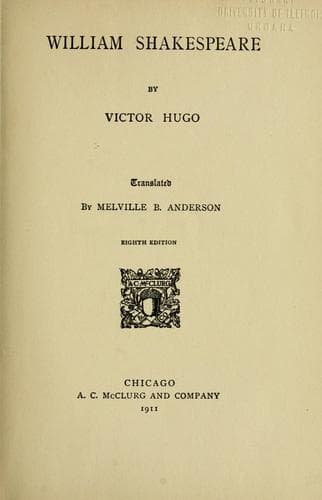
Dramatists, English -- Early modern, 1500-1700 -- Biography; Shakespeare, William, 1564-1616; Stratford-upon-Avon (England) -- Biography
at the sufferings of Christ, finished by suffering on his own account;
the suffering seen made him an apostle, the suffering endured made him
a magician,--the growth of the spirit was the result of the growth of
the trial. Bishop, he writes the gospel; proscribed, he composes the
Apocalypse,--tragic work, written under the dictation of an eagle, the
poet having above his head we know not what mournful flapping of wings.
The whole Bible is between two visionaries,--Moses and John. This poem
of poems merges out of chaos in Genesis, and finishes in the Apocalypse
by thunders. John was one of the great vagrants of the language of
fire. During the Last Supper his head was on the breast of Jesus, and
he could say, "My ear has heard the beating of God's heart." He went
to relate it to men. He spoke a barbarous Greek, mixed with Hebrew
expressions and Syrian words, harsh and grating, yet charming. He went
to Ephesus, he went to Media, he went among the Parthians. He dared to
enter Ctesiphon, a town of the Parthians, built as a counterpoise to
Babylon. He faced the living idol, Cobaris, king, god, and man, forever
immovable on his block, which serves him as throne and latrine. He
evangelized Persia, which the Gospel calls Paras. When he appeared at
the Council of Jerusalem, they thought they saw a pillar of the Church.
He looked with stupefaction at Cerintus and Ebion, who said that Jesus
was but a man. When they questioned him on the mystery, he answered,
"Love you one another?" He died at the age of ninety-four years, under
Trajan. According to tradition, he is not dead; he is spared, and John
is ever living at Patmos as Barberousse at Kaiserslautern. There are
some waiting-caverns for these mysterious everlasting beings. John,
as a historian, has his equals,--Matthew, Luke, Mark; as a visionary
he is alone. There is no dream approaches his, so deep it is in the
infinite. His metaphors pass out from eternity, distracted; his poetry
has a profound smile of madness; the reverberation of the Most High
is in the eye of this man. It is the sublime going fully astray. Men
do not understand it--scorn it, and laugh. "My dear Thiriot," says
Voltaire, "the Apocalypse is filth." Religions, being in want of this
book, have taken to worshipping it; but, in order not to be thrown to
the common sewer, it must be put on the altar. What does it matter?
John is a spirit. It is in the John of Patmos, among all, that the
communication between certain men of genius and the abyss is apparent.
In all other poets men get a glimpse of this communication; in John
they see it, at times they touch it, and have a shivering fit in
placing, so to speak, the hand on this sombre door. That is the way to
the Deity. It seems, when you read the poem of Patmos, that some one
pushes you from behind; you have a confused outline of the dreadful
opening. It fills you with terror and attraction. If John had only
that, he would be immense.
Public-domain text, read in full here on John Shaqi.
Reviews
Reviews
No reviews yet
Be the first to share your thoughts on this work.
Join the Discussion
Join the discussion
Sign in to leave a comment or review.
Sign InorCreate an account