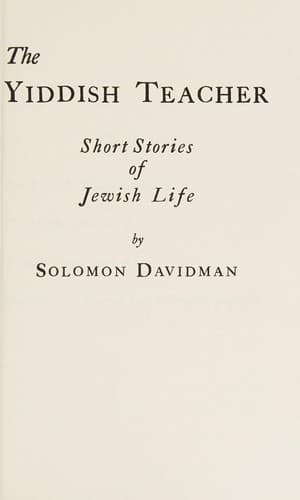
Jewish fiction; Jews -- Fiction; Short stories, Yiddish -- Translations into English; Yiddish fiction -- Translations into English
Because of this, the doctor was so much surprised when he heard his
wife calling him. He understood that something new must have happened,
and he was afraid of this new thing. When he came out of his cabinet he
found his family waiting for him at the table. This was so new to him
that he grew glad and thought to himself that it was a very good thing
to eat together with his children. But in his heart of hearts he was
afraid of the sudden innovation. He was too nervous to wait long, so he
asked as soon as he sat down: “What has happened?”
The children looked at each other, and remained silent. Anna Isakovna,
who felt better than usually, answered: “Nothing has happened.”
At the silence that reigned at the table, the doctor became still more
excited. He cried that something must have happened; that they ought
not torture him, but tell him at once. Anna Isakovna answered him as if
imparting a great sorrow: “Mikhail writes that he is coming home for
Passover.”
The doctor grew silent. The rest were silent also, as if a dead man
were in the house.
That night the doctor did not fall asleep over the “Ryech.” He was
thinking of himself and his son. Truth to say, he did not understand
why Mikhail’s apostasy had made such an impression on him. Neither he
nor his had ever been religious Jews. He himself remembered very little
of his religion. Passover and Yom Kippur were to him merely vague
memories of childhood. His father, a storekeeper in a little town, had
been a pious Jew. But since he had left the town in his youth going to
study in Moscow, he had not seen his father and had lost track of the
holidays. Anna Isakovna, with whom he had become acquainted in Moscow,
and whom he had married there, also knew nothing of Jewish holidays.
And his children were reared like the children of so many parents in
his circumstances, without any traditions. They lived according to
customs and holidays of his Gentile neighbors. And naturally, Mikhail
grew up ripe for Christianity. He was able, and from the fifth grade on
he began to show an exceptional faculty for mathematics. When he began
to study in earnest, no one of the family had the slightest doubt that
Mikhail, in order to avoid the obstacles that lay between himself and
his career, would have to adopt Christianity. The father, the mother,
and Mikhail himself, had always thought so, though they never said a
word about it. Then, why did it torture him so, now that Mikhail had
already done it? What new thing was it that was waking in him, making
him a stranger in his own house?
Public-domain text, read in full here on John Shaqi.
Reviews
Reviews
No reviews yet
Be the first to share your thoughts on this work.
Join the Discussion
Join the discussion
Sign in to leave a comment or review.
Sign InorCreate an account