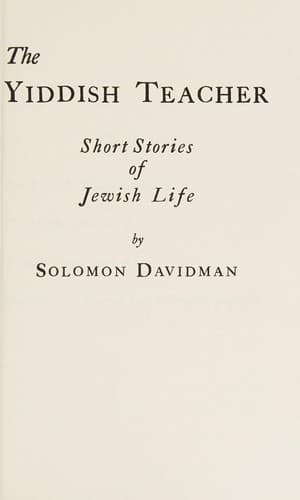
Jewish fiction; Jews -- Fiction; Short stories, Yiddish -- Translations into English; Yiddish fiction -- Translations into English
The doctor had thought much about this in the last days, trying to
revive the memories of his own lost years to the utmost of his powers.
But it was hard. When he began to think of them he would grow tired.
His broad-boned body grew heavy and he became sleepy, for in the
twenty-three years that he had spent in the provincial town within
the Pale, he had forgotten how to think. Once upon a time, like other
students of his age, he had been an idealist. He would finish his
studies, he then thought, and go to the people. He would establish
himself in some out-of-the-way village, there to heal the peasants
and their wives and teach the little boys to read and write, for many
students talked of that at the time. But when Dr. Lazarovitch was
graduated he did not go to any out-of-the-way village. He fell in love
with Anna Isakovna, a daughter of Director Solomon. Solomon, an old,
worked-out factory invalid, who had four daughters, was often visited
by the Jewish students in Moscow. The girls played the piano, and the
Director’s home was aristocratic. The lackey, an old Gentile, served
at the table in gloves, though there was not much to serve. The gloved
lackey and the piano-playing made a deep impression on Dr. Lazarovitch,
and to his share fell the weakest and ugliest of the Director’s
daughters, Anna.
But as soon as he married the aristocrat he forgot all his ideals. He
went with his wife, who began to ail shortly after the wedding, to a
town in the Jewish Pale, where Director Solomon had many relatives and
acquaintances. Here he began to build up a practice. This partly meant
that even in the Pale one could do much, that ideals are necessary
not only in the village, but also in the town. But soon the doctor
became acquainted with the intellectuals of the town, with the druggist
and the President of the Court, and spent most of his nights at the
club, with them, playing cards. He tried to avoid being at home. He
did not love his wife over much after she began to ail, but this did
not prevent his having five children with her, two of which had been
still-born; the other three had grown up almost without his knowledge,
till his card-playing had been interrupted by the apostasy of Mikhail.
* * * * *
Public-domain text, read in full here on John Shaqi.
Reviews
Reviews
No reviews yet
Be the first to share your thoughts on this work.
Join the Discussion
Join the discussion
Sign in to leave a comment or review.
Sign InorCreate an account