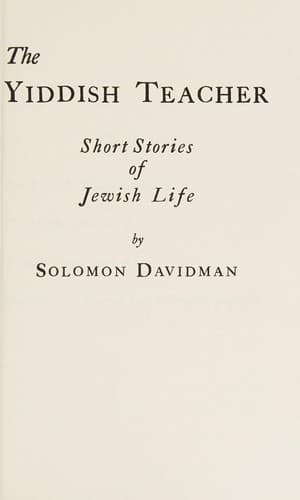
Jewish fiction; Jews -- Fiction; Short stories, Yiddish -- Translations into English; Yiddish fiction -- Translations into English
Throughout the time Mikhail was at home the house seemed dead. The
usual noise of the children on their arrival from school was heard no
longer. The children, who always walked on tiptoe now, could not be
heard in the next room. They sat reading, each in a different corner,
as if they were ashamed to look at each other. The silence strained
the doctor’s nerves still more. He wanted to go to the children many
times, and play with them, as he used to do when they were small. But
as soon as he saw Mikhail through the keyhole, he grew frightened and
restrained himself.
And yet the apostate touched his heart more than the others. It seemed
to him that the boy looked weaker and sadder since he had become a
Christian, and the doctor began to pity him. He had never felt so near
to any of his children before. He was glad and yet sorry that he felt
so toward his son. Once he saw him through a window reading in a corner
of the room, dressed in the blue uniform that fitted him but poorly.
The boy felt strange in the house, and was afraid to talk loud. His
face was pale. In his eyes and about his lips lay the shadow of a great
grief like that which lingers about a girl who has lost her innocence.
The doctor noticed it and a wave of pity swept over him for the child
who was inaugurating his career in such a sin. He could not restrain
himself, walked into the room, approached the boy, laid his wide, thick
hand on the weak, childish shoulders, and looked into Mikhail’s eyes.
“Mikhail, how do you feel?”
The boy trembled. At sight of his father he grew pale, and confusedly
and involuntarily pressing himself to his father, cried: “Papa.” But he
soon reminded himself of something, and remained standing, silent and
shamefaced. “How did you enter the University?” Dr. Lazarovitch asked
roughly, and wiped his thick face with a broad hand.
The boy was silent for a moment. At last he viciously bit his thin pale
lips and answered: “I didn’t know you would take it like this.”
The father was silent.
In a minute the boy again said:
“If you want me to, I will leave the University, and become a Jew
again. Do you think I liked to do it?”
“It is unnecessary,” the father sternly answered.
“Why?” the boy asked.
The doctor moved closer to the boy, looked straight in his eyes, with a
moody, sinister glance, and said: “We aren’t talking of religion. You
know I am not religious. We are discussing a principle. And you have
denied that principle once. What would the good be in your becoming a
Jew again? You can’t change what you have done. Just like a girl who
has lost her honor--she can’t regain it. Understand?”
The doctor seized the boy’s head and kissed him, perhaps for the first
time in his life. Then he left the room.
* * * * *
Public-domain text, read in full here on John Shaqi.
Reviews
Reviews
No reviews yet
Be the first to share your thoughts on this work.
Join the Discussion
Join the discussion
Sign in to leave a comment or review.
Sign InorCreate an account