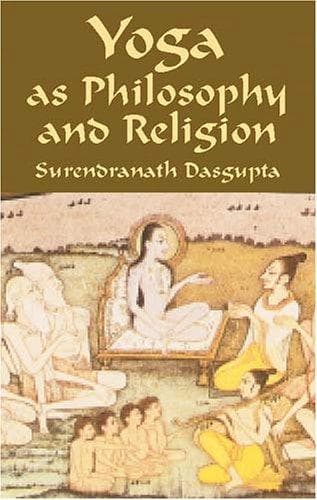
Yoga as philosophy and religionDasgupta, Surendranath
Religion
Yoga as philosophy and religion
Dasgupta, Surendranath
Hindu philosophy; Patañjali; Yoga
In another place there are two sūtras:—(1) _niḥsaṅge’pi uparāgo
vivekāt_. (2) _japāsphaṭikayoriva noparāgaḥ kintvabhimānaḥ_. (1) Though
it be associated still there is a tingeing through non-discrimination.
(2) As in the case of the hibiscus and the crystal, there is not a
tinge, but a fancy. Now it will be seen that all these theories only
show that the transcendent nature of the union of the principle of pure
intelligence is very difficult to comprehend. Neither the reflection nor
the limitation theory can clear the situation from vagueness and
incomprehensibility, which is rather increased by their physical
illustrations, for the cit or pure intelligence cannot undergo
reflection like a physical thing, nor can it be obstructed or limited by
it. The reflection theory adduced by the _Sāṃkhya-sūtra_,
“_japāsphiṭikayoriva noparāgaḥ kintvabhimānaḥ_,” is not an adequate
explanation. For here the reflection produces only a seeming redness of
the colourless crystal, which was not what was meant by the Vedāntists
of the reflection school. But here, though the metaphor is more suitable
to express the relation of purusha with the prakṛti, the exact nature of
the relation is more lost sight of than comprehended. Let us now see how
Patañjali and Vyāsa seek to explain it.
Let me quote a few sūtras of Patañjali and some of the most important
extracts from the _Bhāshya_ and try, as far as possible, to get the
correct view:—
(1) _dṛgdarśanaśaktyorekātmateva asmitā_ II. 6.
(2) _drashṭā dṛśimātraḥ śuddho’pi pratyayānupaśyaḥ_ II. 20.
(3) _tadartha eva drśyasya ātmā_ II. 21.
(4) _kṛtārthaṃ prati nashṭamapyanashṭaṃ tadanyasādhāraṇatvāt_ II. 22.
(5) _Svasvāmiśaktyoḥ svarūpopalabdhihetuḥ saṃyogah_ II. 22.
(6) _tadabhāvāt saṃyogābhāvo hānaṃ taddṛśeḥ kaivalyaṃ_ II. 25.
(7) _sattvapurushayoḥ śuddhisāmye kaivalyaṃ_ III. 25.
(8) _citerapratisaṃkramāyāstadākārāpattau svabuddhisaṃvedanaṃ_ IV. 22.
(9) _sattvapurushayoratyantāsaṅkīrṇayoḥ pratyayāvśesho bhogaḥ
parārthatvāt svārthasaṃyamāt purushajñānam_ III. 35.
(1) The Ego-sense is the illusory appearance of the identity of the
power as perceiver and the power as perceived.
(2) The seer though pure as mere “seeing” yet perceives the forms
assumed by the psychosis (_buddhi_).
(3) It is for the sake of the purusha that the being of the knowable
exists.
(4) For the emancipated person the world-phenomena cease to exist, yet
they are not annihilated since they form a common field of experience
for other individuals.
(5) The cause of the realisation of the natures of the knowable and
purusha in consciousness is their mutual contact.
(6) Cessation is the want of mutual contact arising from the destruction
of ignorance and this is called the state of oneness.
(7) This state of oneness arises out of the equality in purity of the
purusha and buddhi or sattva.
(8) Personal consciousness arises when the purusha, though in its nature
unchangeable, is cast into the mould of the psychosis.
Public-domain text, read in full here on John Shaqi.
Reviews
Reviews
No reviews yet
Be the first to share your thoughts on this work.
Join the Discussion
Join the discussion
Sign in to leave a comment or review.
Sign InorCreate an account