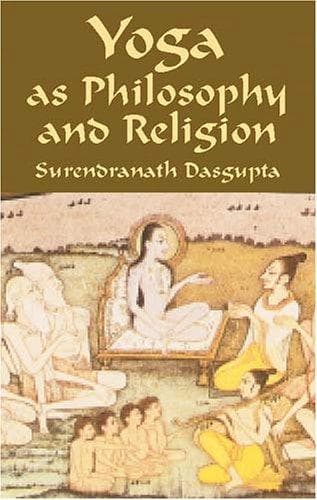
Yoga as philosophy and religionDasgupta, Surendranath
Religion
Yoga as philosophy and religion
Dasgupta, Surendranath
Hindu philosophy; Patañjali; Yoga
(9) Since the mind-objects exist only for the purusha, experience
consists in the non-differentiation of these two which in their natures
are absolutely distinct; the knowledge of self arises out of
concentration on its nature.
Thus in _Yoga-sūtra_, II. 6, dṛik or purusha the seer is spoken of as
śakti or power as much as the prakṛti itself, and we see that their
identity is only apparent. Vyāsa in his _Bhāshya_ explains _ekātmatā_
(unity of nature or identity) as _avibhāgaprāptāviva_, “as if there is
no difference.” And Pañcaśikha, as quoted in _Vyāsa-bhāshya_, writes:
“not knowing the purusha beyond the mind to be different therefrom, in
nature, character and knowledge, etc., a man has the notion of self, in
the mind through delusion.”
Thus we see that when the mind and purusha are known to be separated,
the real nature of purusha is realised. This seeming identity is again
described as that which perceives the particular form of the mind and
thereby appears, as identical with it though it is not so
(_pratyayānupaśya—pratyayāni bauddhamanupaśyati tamanupaśyannatadātmāpi
tadātmaka iva pratibhāti_, _Vāysa-bhāshya_, II. 20).
The purusha thus we see, cognises the phenomena of consciousness after
they have been formed, and though its nature is different from conscious
states yet it appears to be the same. Vyāsa in explaining this sūtra
says that purusha is neither quite similar to the mind nor altogether
different from it. For the mind (_buddhi_) is always changeful,
according to the change of the objects that are offered to it; so that
it may be said to be changeful according as it knows or does not know
objects; but the purusha is not such, for it always appears as the self,
being reflected through the mind by which it is thus connected with the
phenomenal form of knowledge. The notion of self that appears connected
with all our mental phenomena and which always illumines them is only
duo to this reflection of purusha in the mind. All phenomenal knowledge
which has the form of the object can only be transformed into conscious
knowledge as “I know this,” when it becomes connected with the self or
purusha. So the purusha may in a way be said to see again what was
perceived by the mind and thus to impart consciousness by transferring
its illumination into the mind. The mind suffers changes according to
the form of the object of cognition, and thus results a state of
conscious cognition in the shape of “I know it,” when the mind, having
assumed the shape of an object, becomes connected with the constant
factor purusha, through the transcendent reflection or identification of
purusha in the mind. This is what is meant by _pratyayānupaśya_
reperception of the mind-transformations by purusha, whereby the mind
which has assumed the shape of any object of consciousness becomes
intelligent. Even when the mind is without any objective form, it is
always being seen by purusha. The exact nature of this reflection is
Public-domain text, read in full here on John Shaqi.
Reviews
Reviews
No reviews yet
Be the first to share your thoughts on this work.
Join the Discussion
Join the discussion
Sign in to leave a comment or review.
Sign InorCreate an account