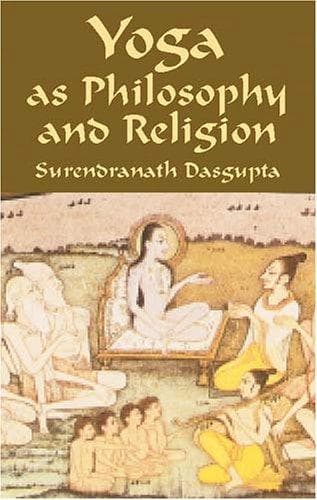
Yoga as philosophy and religionDasgupta, Surendranath
Religion
Yoga as philosophy and religion
Dasgupta, Surendranath
Hindu philosophy; Patañjali; Yoga
indeed very hard to comprehend; no physical illustrations can really
serve to make it clear. And we see that neither the _Vyāsa-bhāshya_ nor
the sūtras offer any such illustrations as Sāṃkhya did. But the
_Bhāshya_ proceeds to show the points in which the mind may be said to
differ from purusha, as well as those in which it agrees with it. So
that though we cannot express it anyhow, we may at least make some
advance towards conceiving the situation.
Thus the _Bhāshya_ says that the main difference between the mind and
purusha is that the mind is constantly undergoing modifications, as it
grasps its objects one by one; for the grasping of an object, the act of
having a percept is nothing but its own undergoing of different
modifications, and thus, since an object sometimes comes within the
grasp of the mind and again disappears in the subconscious as a saṃskāra
(potency) and again comes into the field of the understanding as smṛti
(memory), we see that it is pariṇāmi or changing. But purusha is the
constant seer of the mind when it has an object, as in ordinary forms of
phenomenal knowledge, or when it has no object as in the state of
nirodha or cessation. Purusha is unchanging. It is the light which
remains unchanged amidst all the changing modifications of the mind, so
that we cannot distinguish purusha separately from the mind. This is
what is meant by saying _buddheḥ pratisaṃvedī purushaḥ_, i.e. purusha
reflects or turns into its own light the concepts of mind and thus is
said to know it. Its knowing is manifested in our consciousness as the
ever-persistent notion of the self, which is always a constant factor in
all the phenomena of consciousness. Thus purusha always appears in our
consciousness as the knowing agent. Truly speaking, however, purusha
only sees himself; he is not in any way in touch with the mind. He is
absolutely free from all bondage, absolutely unconnected with prakṛti.
From the side of appearance he seems only to be the intelligent seer
imparting consciousness to our conscious-like conception, though in
reality he remains the seer of himself all the while. The difference
between purusha and prakṛti will be clear when we see that purusha is
altogether independent, existing in and for himself, free from any
bondage whatsoever; but buddhi exists on the other hand for the
enjoyment and release of purusha. That which exists in and for itself,
must ever be the selfsame, unchangeable entity, suffering no
transformations or modifications, for it has no other end owing to which
it will be liable to change. It is the self-centred, self-satisfied
light, which never seeks any other end and never leaves itself. But
prakṛti is not such; it is always undergoing endless, complex
modifications and as such does not exist for itself but for purusha, and
is dependent upon him. The mind is unconscious, while purusha is the
pure light of intelligence, for the three guṇas are all non-intelligent,
Public-domain text, read in full here on John Shaqi.
Reviews
Reviews
No reviews yet
Be the first to share your thoughts on this work.
Join the Discussion
Join the discussion
Sign in to leave a comment or review.
Sign InorCreate an account