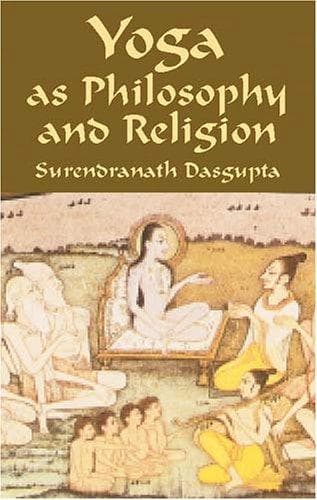
Yoga as philosophy and religionDasgupta, Surendranath
Religion
Yoga as philosophy and religion
Dasgupta, Surendranath
Hindu philosophy; Patañjali; Yoga
and the mind is nothing but a modification of these three guṇas which
are all non-intelligent.
But looked at from another point of view, prakṛti is not altogether
different from purusha; for had it been so how could purusha, which is
absolutely pure, reperceive the mind-modifications? Thus the _Bhāshya_
(II. 20) writes:—
“Well then let him be dissimilar. To meet this he says: He is not quite
dissimilar. Why? Although pure, he sees the ideas after they have come
into the mind. Inasmuch as purusha cognises the ideas in the form of
mind-modification, he appears to be, by the act of cognition, the very
self of the mind although in reality he is not.” As has been said, the
power of the enjoyer, purusha (_dṛkśakti_), is certainly unchangeable
and it does not run after every object. In connection with a changeful
object it appears forever as if it were being transferred to every
object and as if it were assimilating its modifications. And when the
modifications of the mind assume the form of the consciousness by which
it is coloured, they imitate it and look as if they were manifestations
of purusha’s consciousness unqualified by the modifications of the
non-intelligent mind.
All our states of consciousness are analysed into two parts—a permanent
and a changing part. The changing part is the form of our consciousness,
which is constantly varying according to the constant change of its
contents. The permanent part is that pure light of intelligence, by
virtue of which we have the notion of self reflected in our
consciousness. Now, as this self persists through all the varying
changes of the objects of consciousness, it is inferred that the light
which thus shines in our consciousness is unchangeable. Our mind is
constantly suffering a thousand modifications, but the notion of self is
the only thing permanent amidst all this change. It is this self that
imports consciousness to the material parts of our knowledge. All our
concepts originated from our perception of external material objects.
Therefore the forms of our concepts which could exactly and clearly
represent these material objects in their own terms, must be made of a
stuff which in essence is not different from them. But with the
reflection of purusha, the soul, the notion of self comes within the
content of our consciousness, spiritualising, as it were, all our
concepts and making them conscious and intelligent. Thus this seeming
identity of purusha and the mind, by which purusha may be spoken of as
the seer of the concept, appears to the self, which is manifested in
consciousness by virtue of the seeming reflection. For this is that
self, or personality, which remains unchanged all through our
consciousness. Thus our phenomenal intelligent self is partially a
material reality arising out of the seeming interaction of the spirit
and the mind. This interaction is the only way by which matter releases
spirit from its seeming bondage.
Public-domain text, read in full here on John Shaqi.
Reviews
Reviews
No reviews yet
Be the first to share your thoughts on this work.
Join the Discussion
Join the discussion
Sign in to leave a comment or review.
Sign InorCreate an account