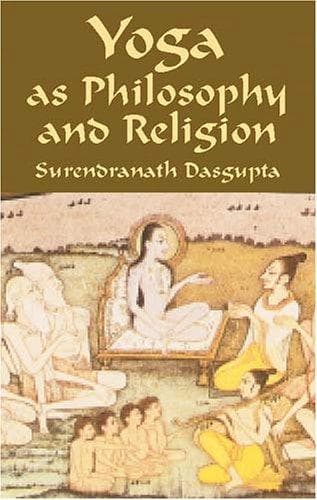
Yoga as philosophy and religionDasgupta, Surendranath
Religion
Yoga as philosophy and religion
Dasgupta, Surendranath
Hindu philosophy; Patañjali; Yoga
For, indeed, it is the experiences of one purusha which
appear in all the seeming different purushas. And in the other
suppositions there is neither emancipation nor enjoyment by purusha at
all. For there, it is only the illusory self that enjoys or releases
himself. By his release no purusha is really released at all. So the
fundamental conception of prakṛti as moving for the sake of the
enjoyment and release of purusha has to be abandoned.
So we see that from the position in which Sāṃkhya and Yoga stood, this
plurality of the purushas was the most consistent thing that they could
think of. Any compromise with the Vedānta doctrine here would have
greatly changed the philosophical aspect and value of the Sāṃkhya
philosophy. As the purushas are nothing but pure intelligences they can
as well be all-pervading though many. But there is another objection
that, since number is a conception of the phenomenal mind, how then can
it be applied to the purushas which are said to be many?[18] But that
difficulty remains unaltered even if we regard the purusha as one. When
we go into the domain of metaphysics and try to represent Reality with
the symbols of our phenomenal conceptions we have really to commit
almost a violence towards it. But we must perforce do this in all our
attempts to express in our own terms that pure, inexpressible, free
illumination which exists in and for itself beyond the range of any
mediation by the concepts or images of our mind. So we see that Sāṃkhya
was not inconsistent in holding the doctrine of the plurality of the
purushas. Patañjali does not say anything about it, since he is more
anxious to discuss other things connected with the presupposition of the
plurality of purusha. Thus he speaks of it only in one place as quoted
above and says that though for a released person this world disappears
altogether, still it remains unchanged in respect to all the other
purushas.
CHAPTER III
THE REALITY OF THE EXTERNAL WORLD
We may now come to the attempt of Yoga to prove the reality of an
external world as against the idealistic Buddhists. In sūtra 12 of the
chapter on kaivalya we find: “The past and the future exist in reality,
since all qualities of things manifest themselves in these three
different ways. The future is the manifestation which is to be. The past
is the appearance which has been experienced. The present is that which
is in active operation. It is this threefold substance which is the
object of knowledge. If it did not exist in reality, there would not
exist a knowledge thereof. How could there be knowledge in the absence
of anything knowable? For this reason the past and present in reality
exist.”[19]
Public-domain text, read in full here on John Shaqi.
Reviews
Reviews
No reviews yet
Be the first to share your thoughts on this work.
Join the Discussion
Join the discussion
Sign in to leave a comment or review.
Sign InorCreate an account