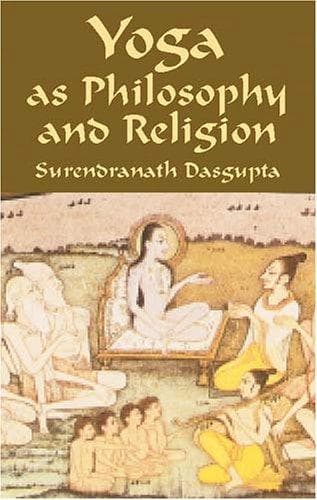
Yoga as philosophy and religionDasgupta, Surendranath
Religion
Yoga as philosophy and religion
Dasgupta, Surendranath
Hindu philosophy; Patañjali; Yoga
So we see that the present holding within itself the past and the future
exists in reality. For the past though it has been negated has really
been preserved and kept in the present, and the future also though it
has not made its appearance yet exists potentially in the present. So,
as we know the past and the future worlds in the present, they both
exist and subsist in the present. That which once existed cannot die,
and that which never existed cannot come to be (_nāstyasataḥ saṃbhavaḥ
na cāsti sato vināsāḥ_, _Vyāsa-bhāshya_, V. 12). So the past has not
been destroyed but has rather shifted its position and hidden itself in
the body of the present, and the future that has not made its appearance
exists in the present only in a potential form. It cannot be argued, as
Vācaspati says, that because the past and the future are not present
therefore they do not exist, for if the past and future do not exist how
can there be a present also, since its existence also is only relative?
So all the three exist as truly as any one of them, and the only
difference among them is the different way or mode of their existence.
He next proceeds to refute the arguments of those idealists who hold
that since the external knowables never exist independently of our
knowledge of them, their separate external existence as such may be
denied. Since it is by knowledge alone that the external knowables can
present themselves to us we may infer that there is really no knowable
external reality apart from knowledge of it, just as we see that in
dream-states knowledge can exist apart from the reality of any external
world.
So it may be argued that there is, indeed, no external reality as
it appears to us. The Buddhists, for example, hold that a blue
thing and knowledge of it as blue are identical owing to the maxim
that things which are invariably perceived together are one
(_sahopalambhaniyamādabhedo nīlataddhiyoḥ_). So they say that
external reality is not different from our idea of it. To this it
may be replied that if, as you say, external reality is identical
with my ideas and there is no other external reality existing as
such outside my ideas, why then does it appear as existing apart,
outside and independent of my ideas? The idealists have no basis
for the denial of external reality, and for their assertion that
it is only the creation of our imagination like experiences in
dreams. Even our ideas carry with them the notion that reality
exists outside our mental experiences. If all our percepts and
notions as this and that arise only by virtue of the influence of
the external world, how can they deny the existence of the
external world as such? The objective world is present by its own
power. How then can this objective world be given up on the
strength of mere logical or speculative abstraction?
Public-domain text, read in full here on John Shaqi.
Reviews
Reviews
No reviews yet
Be the first to share your thoughts on this work.
Join the Discussion
Join the discussion
Sign in to leave a comment or review.
Sign InorCreate an account