Six Dynasties (220-589)
Sui dynasty (589-618)
Tang dynasty (618-907)
Five Dynasties (907-960)
Northern Sung dynasty (960-1127)
Southern Sung dynasty (1127-1279)
Yuan (Mongol) dynasty (1279-1368)
Ming dynasty (1368-1644)
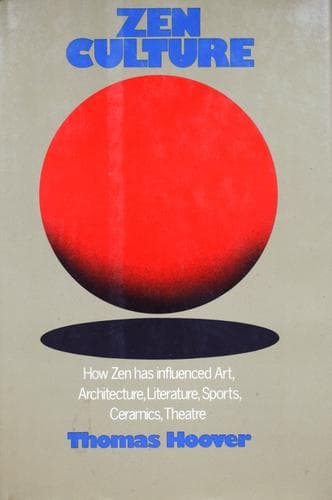
ZEN CULTURE
Foreword
ANYONE WHO EXAMINES the Zen arts is immediately struck by how modern they
seem. Many of the most famous stone gardens are abstract expressionism
pure and simple, created out of found objects. The ceramics of the
sixteenth-century Zen artists could be interchanged with the rugged
pots of our own contemporary crafts movement and few people would
notice a difference. Ancient Zen calligraphies, bold and slashing,
suggest the monochromes of Franz Kline or Willem de Kooning, and if the
word "impressionistic" has any real meaning left, the spontaneous,
intuitive, impulsive Zen painters should have first claim to it. The
apparent nonsense and illogic of Zen parables established the
limitations of language long before the theater of the absurd decided
to ridicule our modern doublespeak; indeed, our new-found skepticism
about language as a medium for communication was a commonplace to
Japanese artists who created both a drama (the No) and a poetry (the
Haiku) that neatly circumvent reliance on mere words for expression--and
in two entirely different ways. Four-hundred-year-old Zen architecture
appears to be virtually a copy of contemporary design ideas: modular
sizing, exposed woods and materials, movable partitions,
multifunctional rooms, bare walls and uncluttered space, indirect
lighting effects, and a California marriage of house and garden. The
celebrated tea ceremony might be considered an early form of Japanese
group therapy, while Zen landscape gardens are nothing less than a
masterful deception masquerading as the "natural" look.
If all this were not coincidence enough, consider for a moment our
present-day artistic conventions and aesthetic ideals. Like much of
what we consider "modern," Zen arts tend to be as simple as possible,
with clean, even severe, lines. Decoration for its own sake is
virtually nonexistent; Zen artists had no more taste for the ornate
than we do today. The works of medieval Zen artists were rough and
asymmetrical, with a skillful exploitation of deliberate imperfections
and blemishes to make the viewer aware of both the materials used and
the process of creation. If it is true that classic art makes one aware
of the form and romantic art makes one aware of the artist, Zen art
makes one aware of the work of art itself.
Public-domain text, read in full here on John Shaqi.
Reviews
Reviews
No reviews yet
Be the first to share your thoughts on this work.
Join the Discussion
Join the discussion
Sign in to leave a comment or review.
Sign InorCreate an account