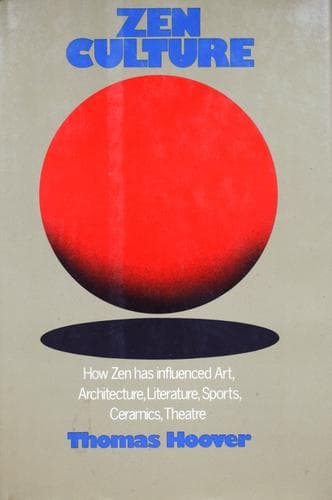
We have absorbed into our Western culture almost unawares such Zen
cultural forms and aesthetic principles as Japanese ideas of
architecture, gardens, and flower arranging. Other forms, such as Haiku
poetry and Zen-style ceramics, we have borrowed in a more open-handed
way, freely acknowledging the source. Actually, none of the Zen arts is
really out of our reach, and a critical following has developed in the
West for almost all of them. The great Irish poet and dramatist William
Butler Yeats embraced the Zen-inspired No drama, although he probably
knew next to nothing about Zen. (For that matter, we should recall that
no English-language books were written on Zen until well into the
twentieth century.) It seems fair to say that the Zen arts have touched
us because they express some view of the world that we have, several
hundred years later, quite independently come to share.
Yet for all the seeming familiarity, there remains an alien quality. We
are not always aware of the really quite extraordinary mind
manipulation inherent in Zen art. Why, for instance, does a Japanese
garden often seem much larger than it really is? How does the Japanese-
style room alter human perception in such a way that people's
experience of each other is intensified? Why do Zen ceramics always
manage to make one take special notice of their surface? This subtle
manipulation of perception is all done by ingenious but carefully
hidden tricks. But since the Zen arts appear so modern, we are lulled
out of looking below the surface to find the fundamental differences.
Most important of all, it is easy to miss what is surely the most
significant quality of Zen arts--their ability to unlock our powers of
direct perception. Since Zen teaches that categories and systematic
analysis hinder real understanding of the outer
(or inner) world, many Zen arts are specifically designed to awaken our
latent ability to perceive directly. They appear innocent enough on the
surface, but they involve a subtle mind- massage not obvious to a
casual observer. It is this added dimension of Zen art that truly sets
it apart from anything we have produced in the twentieth century.
In these pages I will attempt to trace the history and characteristics
of both Zen and the Zen arts--to explain where they came from, why they
arose, what they were intended to do, and how they go about doing it. I
have also included some Western-style analysis of their very non-
Western qualities. The aesthetic ideas embedded in Zen culture and its
perception-inducing works of art are among the most stunning
achievements in world art history. Zen culture, concerned as it is with
the process of perception as much as with actual works of art, can open
our senses so that we experience anew the arts of both East and West,
ancient and modern.
Contents
PART I: The Beginnings: Prehistory to 1333
Public-domain text, read in full here on John Shaqi.
Reviews
Reviews
No reviews yet
Be the first to share your thoughts on this work.
Join the Discussion
Join the discussion
Sign in to leave a comment or review.
Sign InorCreate an account