
Western1694–1778
Voltaire
Paris
French Enlightenment writer and champion of reason, tolerance, and civil liberty.
Biography
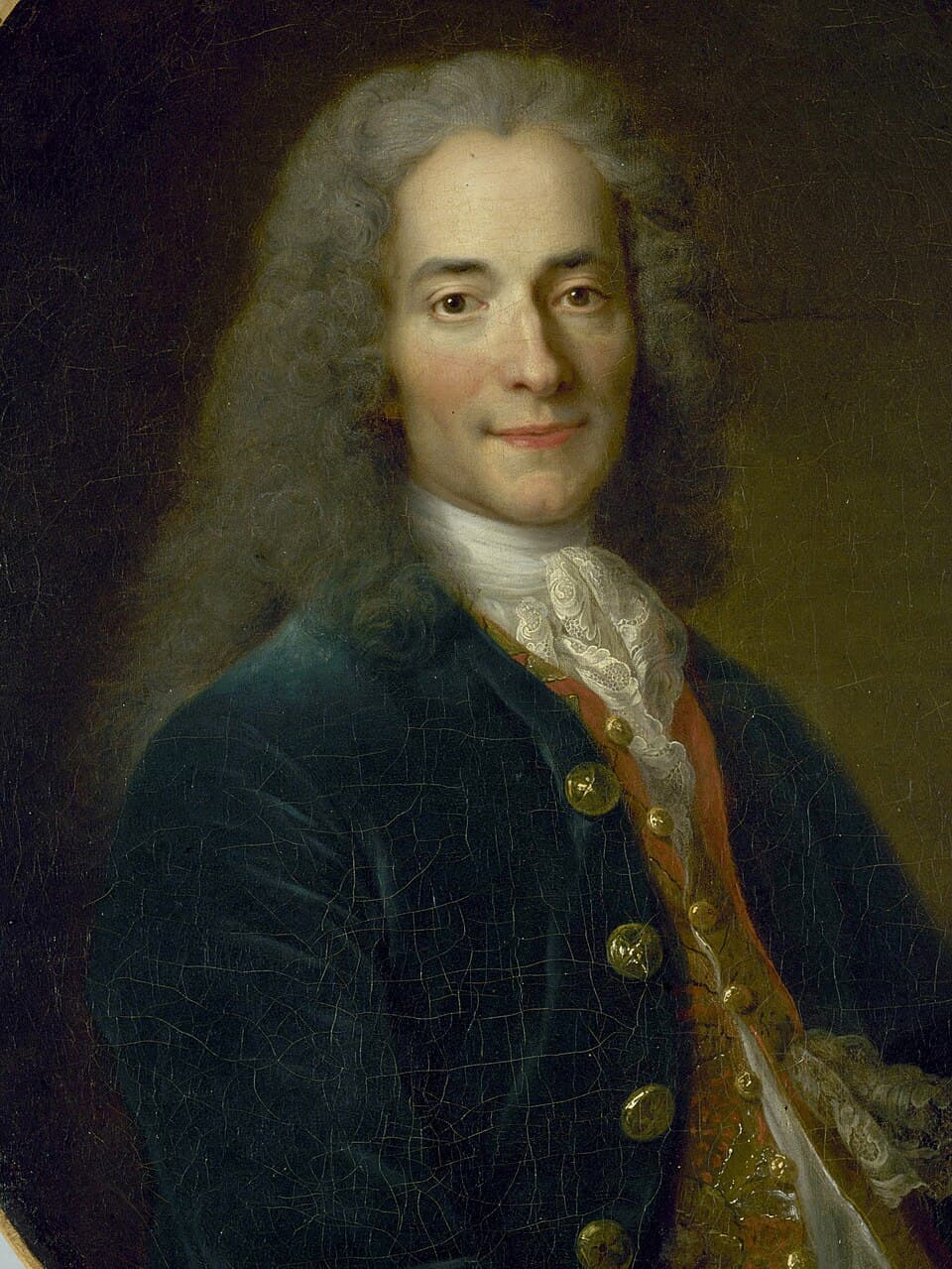
Voltaire — born François-Marie Arouet — was the eighteenth century's most famous man: playwright, historian, pamphleteer, twice a prisoner in the Bastille, exile in England, millionaire by speculation, and for his last quarter-century the "patriarch of Ferney," running a one-man human-rights bureau from an estate straddling the French-Swiss border.
He is remembered as religion's scourge; the truth is sharper. Voltaire was a deist, not an atheist. The order of nature convinced him of a divine intelligence — "the universe embarrasses me," he wrote in verse, "and I cannot dream that this clock exists and has no clockmaker" — and he argued against the atheism of d'Holbach's circle. What he warred on was l'infâme — the infamy — his name for persecuting, dogmatic, miracle-mongering institutional religion. "Écrasez l'infâme" signed hundreds of his letters.
The Philosophical Dictionary (1764) and Candide (1759) carry the two blades. Candide — written after the Lisbon earthquake of 1755 killed tens of thousands on All Saints' Day — destroys Leibnizian optimism ("all is for the best in the best of all possible worlds") by marching its innocent hero through war, Inquisition, and shipwreck; it remains the most readable treatment of the problem of evil ever written. The Dictionary's articles — "Faith," "Fanaticism," "Miracles," "Theist" — perfected the weaponized encyclopedia entry.
His finest hours were casework: the campaign that posthumously exonerated Jean Calas, a Protestant broken on the wheel in Toulouse on a fabricated charge, argued in the Treatise on Toleration (1763). He died in Paris in 1778, denied Christian burial and smuggled into consecrated ground anyway — a final Voltairean joke. Every argument that separates God from the crimes of God's ministries owes him its tone.
Works













Letters on England
en
English literature -- 18th century -- History and criticism; Great Britain -- Civilization -- 18th century; Great Britain -- Intellectual life -- 18th century; Great Britain -- Religion; Imaginary letters; Philosophy, Modern -- 18th century

Micromegas
en
Interplanetary voyages -- Fiction; Life on other planets -- Fiction; Science fiction; Short stories; Voyages, Imaginary -- Fiction

The Fourth Book of Virgil's Aeneid and the Ninth Book of Voltaire's Henriad
en
Virgil. Aeneis; Voltaire, 1694-1778. Henriade
The History of Peter the Great, Emperor of Russia
en
Peter I, Emperor of Russia, 1672-1725; Russia -- History -- Peter I, 1689-1725

The Memoirs of Jacques Casanova de Seingalt, 1725-1798. Volume 15: With Voltaire
en
Casanova, Giacomo, 1725-1798; Europe -- History -- 18th century -- Biography
The Works of Voltaire, Vol. IV of XLIII.: Romances, Vol. III of III, and A Treatise on Toleration.
en
Voltaire, 1694-1778 -- Translations into English
Toleration and other essays
en
Bible -- Controversial literature; Christianity -- Controversial literature; Rationalism; Religion -- Controversial literature; Toleration -- Early works to 1800





Zadig; Or, The Book of Fate
en
French literature -- 18th century; Manners and customs -- Fiction; Political fiction, French
Quote Attribution
Identify the philosopher behind a quote using AI.
Books by & about Voltaire
Works by and about Voltaire — readable in full, right here in the Library.
Read on site →
Read on site →
Read on site →
Read on site →
Read on site →
Read on site →
Read on site →
Read on site →
Read on site →
Read on site →
Read on site →

Read on site →
Read on site →
Read on site →
Read on site →
Read on site →
Read on site →
Read on site →
Read on site →

Read on site →
Read on site →
Read on site →
Read on site →
Read on site →